...dead (as of September 24, 2011), according to Edward Docx in his article of the same title for Prospect Magazine. How so? Well, it was a week or so ago that the Victoria and Albert Museum opened the exhibition, "Postmodernism--Style and Subversion 1970-1990". So, if you're like me and have had difficulty for years trying to understand exactly how to define postmodernism, then you're in luck because it's apparently over and an esteemed museum will pinpoint exactly when it started, ended, and what it was.
 | ||||||
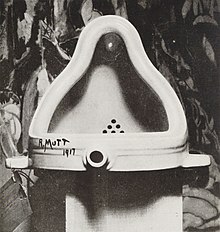
| Marcel Duchamp's Fountain, 1917 |
(Interestingly, Docx suggests that Duchamp, among other modernists, planted the seed for postmodernism, so perhaps the V&A's title timeline is a bit off.)
Seriously, to my mind, this article is a great read; it outlines some of the ideas behind postmodernism, which like so many other "styles", (in art/architecture, dance, music, literature), was a reaction to previous one(s), namely modernism. Per Docx, "Postmodernism was a high-energy revolt, an attack, a strategy for destruction." Yet because it attacked everything, folks became increasingly bewildered and in doubt as to what constitutes great art. And, as Docx argues, using artist Damien Hirst and his diamond skull, For the Love of God, 2007 as a prime example, "artistic success has become about nothing except money...". In other words, postmodernism's removal of criteria results in the market being the only thing left. And this notion leads to Docx's point about what has replaced postmodernism now that it's dead: "The Age of Authenticism."
 |
| Damien Hirst, For the Love of God, 2007 |
The rise of new media and digital art forms seems at odds with this assessment; however, I for one am right in there with Docx's argument that social media has resulted in "...a secondary reverse effect--a universal yearning for some kind of offline authenticity."
Thoughts?